

Hearing Aids Market to Reach US$ 13.1 Billion by 2033 at 7.7% CAGR | Persistence Market Research
Hearing Aids Market
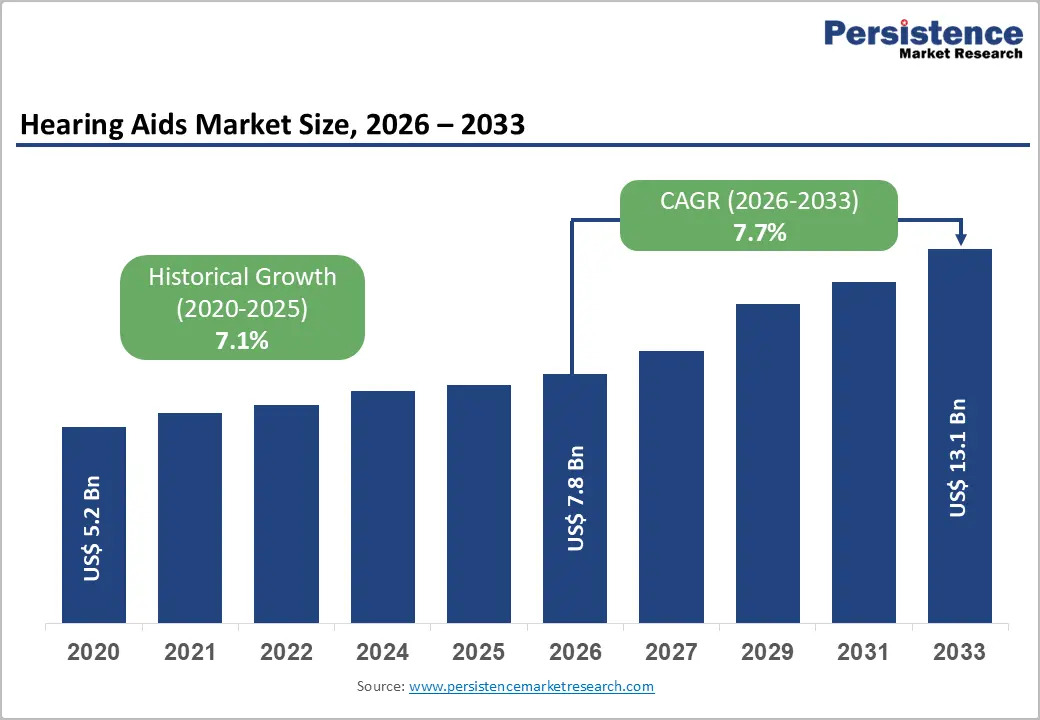
BRENFORD, LONDON, UNITED KINGDOM, July 7, 2026 /EINPresswire.com/ -- The global Hearing Aids Market is witnessing steady expansion as awareness regarding hearing impairment continues to rise across all age groups. Technological advancements, increasing diagnosis rates, and better accessibility to hearing care solutions are encouraging broader adoption worldwide. Modern hearing aids now provide enhanced sound quality, wireless connectivity, AI-assisted personalization, and improved comfort, making them more appealing to users. Growing healthcare investments and favorable reimbursement policies in several countries are also supporting market growth. According to Persistence Market Research, the global hearing aids market size is expected to be valued at US$ 7.8 billion in 2026 and is projected to reach US$ 13.1 billion by 2033, expanding at a CAGR of 7.7% between 2026 and 2033.
The market is primarily driven by the rising prevalence of hearing loss, rapid technological innovation, and increasing adoption of digital hearing solutions. Behind-the-ear and receiver-in-canal devices continue to attract strong consumer demand because of their comfort, durability, and advanced features. Adult users account for the largest share owing to the increasing incidence of age-related hearing disorders, while pediatric adoption is also improving through early diagnosis programs. North America remains the leading regional market due to advanced healthcare infrastructure, high awareness levels, supportive reimbursement systems, and strong presence of leading hearing aid manufacturers investing in product innovation and digital hearing technologies.
Want Market Insights? Get Your Free Report Sample : https://www.persistencemarketresearch.com/samples/4414
Key Highlights from the Report
➤ The global Hearing Aids Market is expected to grow from US$ 7.8 billion in 2026 to US$ 13.1 billion by 2033, registering a CAGR of 7.7%.
➤ Continuous innovation in AI-enabled and Bluetooth-enabled hearing aids is improving user experience and market demand.
➤ Rising awareness regarding hearing health is encouraging early diagnosis and timely adoption of advanced hearing devices.
➤ Digital hearing aid technologies are replacing conventional products due to superior sound quality and customization.
➤ Increasing elderly population worldwide continues to create long-term growth opportunities for manufacturers.
➤ Expanding distribution through audiology clinics, hospitals, and online platforms is improving product accessibility.
Market Segmentation
The Hearing Aids Market is segmented based on product type, technology, patient category, distribution channel, and end user. Digital hearing aids continue to dominate due to their advanced noise reduction, speech enhancement, wireless connectivity, and personalized listening experiences. Analog devices continue serving selected users seeking affordable alternatives, while rechargeable hearing aids are gaining preference because of convenience and reduced battery replacement requirements. Continuous product innovation has significantly expanded consumer choices across different price ranges and performance levels.
Based on end users, adults represent the largest market segment owing to the increasing incidence of age-related hearing impairment. Pediatric hearing care is also gaining attention as governments and healthcare providers promote early hearing screening initiatives. Distribution channels include hospitals, audiology centers, hearing care clinics, retail stores, and online platforms. Growing adoption of tele-audiology and digital consultations is creating greater accessibility for patients while improving hearing aid fitting, follow-up care, and customer satisfaction.
Customize This Report for Your Exact Requirements : https://www.persistencemarketresearch.com/request-customization/4414
Regional Insights
North America continues to lead the Hearing Aids Market because of high healthcare expenditure, favorable reimbursement programs, strong awareness regarding hearing health, and early adoption of technologically advanced hearing solutions. Continuous investment in research and development, coupled with widespread availability of hearing care professionals, supports sustained market expansion across the region.
Europe also represents a significant market supported by aging demographics, established healthcare systems, and increasing adoption of digital hearing technologies. Meanwhile, Asia Pacific is emerging as a rapidly developing region due to improving healthcare infrastructure, rising disposable income, expanding awareness campaigns, and growing access to hearing healthcare services in both urban and rural areas.
Market Drivers
The growing prevalence of hearing disorders remains the strongest growth driver for the Hearing Aids Market. Increasing life expectancy has resulted in a larger elderly population that frequently experiences hearing impairment. Rising awareness regarding untreated hearing loss and its impact on communication, cognitive health, and quality of life has encouraged more individuals to seek professional diagnosis and treatment. Government initiatives promoting hearing screening programs are further supporting early detection and product adoption.
Technological innovation is another major growth catalyst. Manufacturers are introducing hearing aids featuring artificial intelligence, smartphone integration, rechargeable batteries, noise cancellation, directional microphones, and personalized sound optimization. These innovations significantly improve user comfort, listening quality, and convenience, encouraging both first-time users and existing customers to upgrade to advanced hearing solutions.
Market Restraints
Despite positive growth prospects, the Hearing Aids Market faces several challenges. High product costs continue to limit accessibility for many patients, particularly in developing economies where insurance coverage remains limited. Professional fitting, regular maintenance, and replacement expenses further increase the overall ownership cost, discouraging wider adoption among price-sensitive consumers.
Social stigma associated with hearing aid usage also affects market penetration. Many individuals delay treatment because they perceive hearing devices as signs of aging or disability. Limited awareness in underserved regions, shortage of trained audiologists, and inconsistent reimbursement policies further restrict market growth despite continuous technological improvements.
Unlock Complete Insights – Buy the Full Report : https://www.persistencemarketresearch.com/checkout/4414
Market Opportunities
Significant opportunities are emerging through digital healthcare transformation and tele-audiology services. Remote hearing assessments, virtual consultations, and software-based device adjustments enable manufacturers and healthcare providers to reach patients in remote locations more efficiently. Growing smartphone adoption also supports seamless integration between hearing aids and digital health applications.
Emerging economies present substantial long-term growth opportunities as healthcare infrastructure improves and awareness regarding hearing health increases. Continuous investments in affordable hearing technologies, rechargeable devices, AI-powered sound processing, and personalized hearing solutions are expected to create new revenue streams for manufacturers while expanding access to hearing care globally.
Company Insights
Key players operating in the Hearing Aids Market include Sonova Holding AG, Demant A/S, WS Audiology, GN Store Nord A/S, Starkey, Cochlear Limited, MED-EL, Sivantos, RION Co., Ltd., and Eargo Inc.
Explore the Latest Trending Research Reports:
Veterinary Medicine Market
Dental Burs Market
Persistence Market Research
Persistence Market Research Pvt Ltd
+1 646-878-6329
email us here
Visit us on social media:
LinkedIn
Instagram
Facebook
YouTube
X
Legal Disclaimer:
EIN Presswire provides this news content "as is" without warranty of any kind. We do not accept any responsibility or liability for the accuracy, content, images, videos, licenses, completeness, legality, or reliability of the information contained in this article. If you have any complaints or copyright issues related to this article, kindly contact the author above.
