

Location-Based Services Market to Hit US$150.2 Bn by 2033 Amid 19.1% CAGR Growth
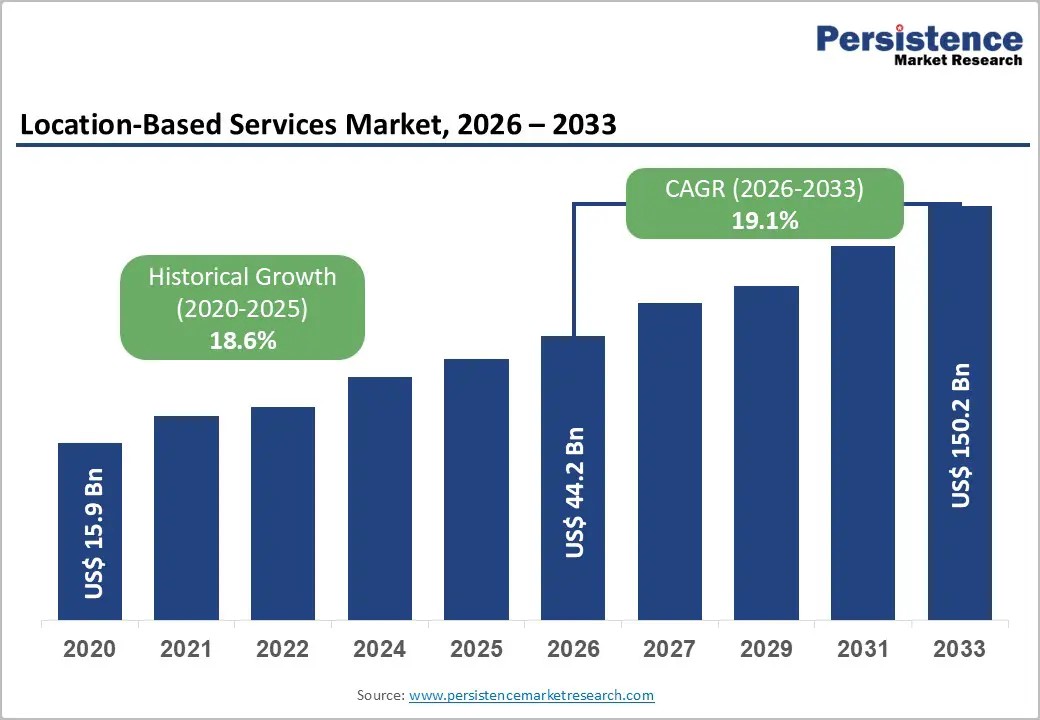
Global location-based services (LBS) market to grow from US$44.2 Bn in 2026 to US$150.2 Bn by 2033, registering a 19.1% CAGR driven by mobile and IoT adoption
BRENTFORD, ENGLAND, UNITED KINGDOM, March 10, 2026 /EINPresswire.com/ -- The global Location-Based Services (LBS) market is rapidly evolving as industries increasingly rely on real-time location intelligence to improve services and user experiences. LBS technologies are widely used across sectors such as transportation, retail, healthcare, and logistics to deliver contextual information, optimize operations, and support data-driven decision-making.
The market is projected to grow from US$44.2 billion in 2026 to US$150.2 billion by 2033, expanding at a CAGR of 19.1%. This growth is driven by rising smartphone adoption, advancements in positioning technologies, and expanding applications in smart cities and digital commerce.
Innovations in GPS, 5G connectivity, IoT, and big data analytics are further enhancing location intelligence capabilities. As connected devices and digital infrastructure continue to expand, businesses are increasingly leveraging LBS solutions for navigation, targeted marketing, logistics optimization, and emergency response services.
𝐆𝐞𝐭 𝐚 𝐒𝐚𝐦𝐩𝐥𝐞 𝐏𝐃𝐅 𝐁𝐫𝐨𝐜𝐡𝐮𝐫𝐞 𝐨𝐟 𝐭𝐡𝐞 𝐑𝐞𝐩𝐨𝐫𝐭: https://www.persistencemarketresearch.com/samples/24478
Market Drivers
Proliferation of Smartphones and Connected Devices
The widespread adoption of smartphones and connected devices has become one of the strongest drivers of the location-based services market. Modern smartphones are equipped with technologies such as GPS, Bluetooth, Wi-Fi, and advanced sensors, allowing highly accurate real-time tracking.
Businesses are increasingly leveraging location data to deliver hyper-personalized services to customers. For instance, retailers can send promotional offers when customers are near their stores, while logistics companies can optimize delivery routes using location insights.
The growth of the Internet of Things (IoT) further enhances the value of LBS by connecting billions of devices that continuously generate location data. These devices include wearable technologies, smart vehicles, drones, and industrial equipment.
When combined with high-speed connectivity such as 5G networks, these technologies enable businesses to perform advanced analytics, predictive modeling, and real-time decision-making. As a result, organizations are increasingly integrating LBS capabilities into their digital transformation strategies.
Market Challenges
Privacy and Data Security Concerns
Despite the rapid expansion of location-based services, data privacy and security concerns remain significant barriers to adoption. Location data can reveal highly sensitive information about individuals, including movement patterns, preferences, and daily routines.
Consumers are increasingly cautious about sharing location information, especially when organizations use this data for targeted advertising or behavioral profiling without clear consent.
Businesses operating in the LBS market must therefore adopt privacy-by-design principles and implement robust cybersecurity measures. Technologies such as encryption, anonymization, and secure authentication are essential for protecting user data.
Regulatory frameworks such as the General Data Protection Regulation (GDPR) have also introduced strict requirements regarding data collection, consent, and transparency. Companies that fail to comply with these regulations risk facing heavy fines and reputational damage.
To build trust with users, organizations must prioritize transparent policies, ethical data practices, and strong security infrastructure.
Technology Insights
GPS Technology Leading the Market
Global Positioning System (GPS) technology is expected to remain the dominant segment in the LBS market, accounting for approximately 45% of revenue share in 2026.
GPS provides reliable and accurate location information for various applications, including navigation, fleet management, geofencing, and logistics tracking.
In August 2025, TRAC Intermodal launched GeoFleet, a GPS-enabled platform designed to optimize chassis availability and provide real-time tracking for shipping operations. The solution enables usage-based billing and improves supply chain efficiency.
The widespread integration of GPS into smartphones, vehicles, and wearable devices ensures that this technology will continue to play a central role in the location-based services ecosystem.
5G-Enabled Location Services
The rollout of 5G connectivity is expected to transform the LBS market by enabling ultra-fast and highly accurate location services.
5G networks provide:
Low latency connectivity
Faster data transfer speeds
Higher device density support
These capabilities allow real-time applications such as autonomous vehicles, smart city infrastructure, and advanced emergency services to operate more efficiently.
In September 2025, Airtel Business partnered with Swift Navigation to launch Airtel-Skylark, a cloud-based location platform delivering centimeter-level accuracy for industries including transportation, industrial operations, and smart mobility.
As 5G adoption continues to expand globally, demand for advanced LBS technologies is expected to grow significantly.
End-User Industry Insights
Transportation and Logistics
The transportation and logistics sector is expected to account for approximately 30% of the global LBS market revenue in 2026.
Location-based services enable logistics companies to monitor shipments, optimize delivery routes, and improve supply chain transparency.
Real-time tracking improves customer satisfaction by providing accurate delivery updates and reducing delays. Additionally, route optimization helps companies reduce fuel consumption and operational costs.
As global e-commerce continues to expand, logistics companies are expected to increasingly rely on LBS technologies to maintain efficient operations.
Healthcare
Healthcare is projected to become the fastest-growing end-user segment for location-based services during the forecast period.
Hospitals and healthcare providers are adopting LBS solutions for applications such as:
Patient tracking within healthcare facilities
Monitoring medical equipment and assets
Managing emergency response teams
Supporting telemedicine and remote healthcare services
These technologies improve patient safety and operational efficiency while enabling faster response times during emergencies.
As healthcare systems become increasingly digitalized, location intelligence is expected to play a crucial role in improving service delivery.
𝐃𝐨 𝐘𝐨𝐮 𝐇𝐚𝐯𝐞 𝐀𝐧𝐲 𝐐𝐮𝐞𝐫𝐲 𝐎𝐫 𝐒𝐩𝐞𝐜𝐢𝐟𝐢𝐜 𝐑𝐞𝐪𝐮𝐢𝐫𝐞𝐦𝐞𝐧𝐭? 𝐑𝐞𝐪𝐮𝐞𝐬𝐭 𝐂𝐮𝐬𝐭𝐨𝐦𝐢𝐳𝐚𝐭𝐢𝐨𝐧 𝐨𝐟 𝐑𝐞𝐩𝐨𝐫𝐭: https://www.persistencemarketresearch.com/request-customization/24478
Competitive Landscape
The global location-based services market is moderately consolidated, with several major technology companies leading the industry.
Leading players include:
Apple
HERE Technologies
TomTom
Qualcomm
Foursquare
Uber Technologies
Garmin
Sygic
Telenav
𝐁𝐮𝐲 𝐍𝐨𝐰 𝐭𝐡𝐞 𝐃𝐞𝐭𝐚𝐢𝐥𝐞𝐝 𝐑𝐞𝐩𝐨𝐫𝐭: https://www.persistencemarketresearch.com/checkout/24478
Conclusion
The global location-based services market is entering a period of rapid expansion driven by technological innovation and the increasing demand for real-time geographic data.
With the market projected to grow from US$44.2 billion in 2026 to US$150.2 billion by 2033, location intelligence is becoming a core component of modern digital infrastructure.
Advancements in 5G connectivity, IoT integration, and indoor positioning technologies will continue to unlock new applications across industries. At the same time, businesses must address privacy and security concerns to ensure sustainable growth.
As organizations increasingly recognize the strategic value of location data, location-based services are poised to transform how businesses interact with customers, manage operations, and shape the future of digital ecosystems.
Related Reports:
Pooja Gawai
Persistence Market Research
+1 646-878-6329
email us here
Visit us on social media:
LinkedIn
Instagram
Facebook
YouTube
Legal Disclaimer:
EIN Presswire provides this news content "as is" without warranty of any kind. We do not accept any responsibility or liability for the accuracy, content, images, videos, licenses, completeness, legality, or reliability of the information contained in this article. If you have any complaints or copyright issues related to this article, kindly contact the author above.
